

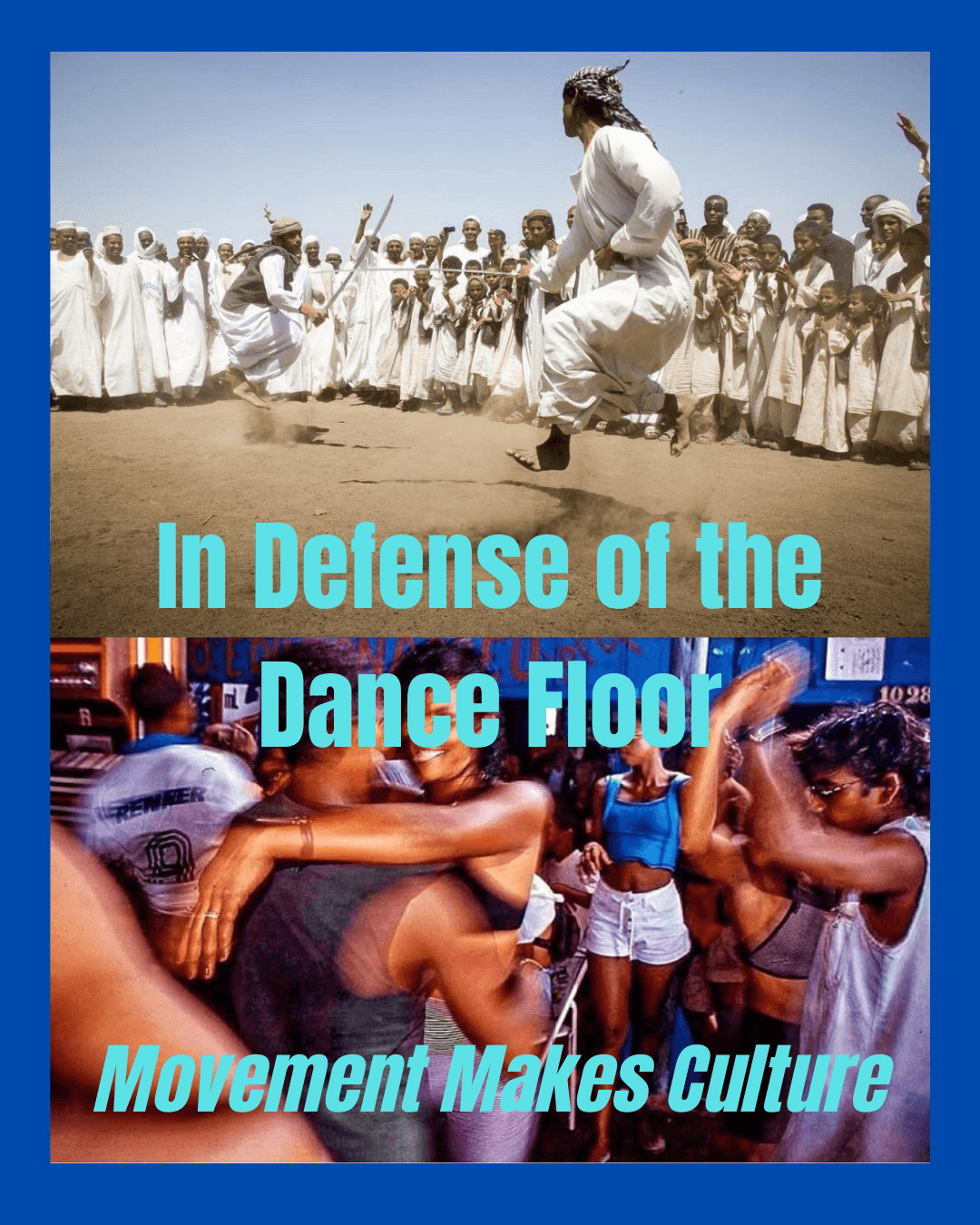
It is difficult to imagine human gatherings without some form of movement. Archaeological evidence points to dance being part of early human life in ways that went far beyond entertainment: ritual, ceremony, courtship, mourning, celebration. In many cultures, movement wasn’t something separate from music, religion, or community. It was woven into all of them. People danced for the harvest. They danced at weddings and funerals. They danced to mark important moments, to celebrate, to grieve, to connect with one another. There wasn’t really a distinction between dancing and living because, for a very long =me, dancing was simply one of the ways people lived together. Animals have been observed in mating rituals, dancing to court each other. In other words, dancing is not just any act; it’s an innate instinct.
The same communal instinct persisted through medieval Europe, where social dances became part of festivals, feasts and seasonal celebrations. Dancing was collective rather than individual; it belonged to the village, the square, the court, the celebration. There was no audience in the modern sense. There were simply people participating.
Take dabke. Across the Levant, the dance has traditionally been part of weddings, festivals and other gatherings, with people joining hands or linking shoulders and moving together in a line. In Palestine, UNESCO describes it as both a celebration and a way of strengthening social ties, with younger generations learning it simply by being around it; at family celebrations, in schools, at weddings, watching older people do it and eventually joining in themselves.
There is something deeply moving about that kind of dance because nobody is really dancing alone. The point is the line. You are connected to the person beside you, matching their steps, keeping the rhythm together. In other words, the dance is doing exactly what a good dance floor still does now: turning a group of separate people into something that feels briefly collective. And this isn’t unique to the Levant. Across the Arab world, dance, music and poetry have long been tied to weddings, religious celebrations, national occasions and community gatherings. In Saudi Arabia, Alardah combines drumming, poetry and coordinated movement; in the UAE and Oman, Al-Razfa brings people together in two facing lines accompanied by chanting and drums.
By the 1800s, particularly in Europe, dancing had also become one of the few socially acceptable ways for young men and women to interact with one another. At formal balls and assemblies, courtship was conducted through a surprisingly structured language of movement. Who you asked to dance with, how often you danced together, who you were seen speaking to between dances– all of it carries meaning. The Waltz is probably the most famous example. When it became popular across Europe in the early nineteenth century, its close physical contact was considered scandalous by some contemporary observers. Men and women were suddenly moving around a room together, holding one another, without the usual social distance that governed polite society. And yet the dance became enormously popular. The floor offered something that ordinary social life often didn’t: a reason to get close to someone. You could ask someone to dance without having to announce that you were interested in them. You could spend a few minutes with someone you barely knew, see how they moved, whether they made you laugh, whether they stepped on your feet. There was a whole social language happening underneath the music.
During the Great Depression in the United States, when unemployment and poverty were widespread, dance halls remained important social spaces, and swing became one of the defining cultural movements of the era. The Lindy Hop emerged from Harlem’s communities and spread through American popular culture in the 1930s and 1940s, eventually becoming inseparable from the swing era. The country was dealing with economic hardship and then a world war. People still danced.
We tend to think of pleasure as something that should come after survival. First you fix your life, then you celebrate. First the economy improves, then you go out. First the war ends, then you dance, but history doesn’t really support that order. People dance because things are difficult.
Disco is another example. It developed within New York’s underground nightlife and became a mainstream cultural force in the 1970s, a decade marked by economic instability, inflation, and social upheaval. Its rise was not simply a story about people wanting to have fun. The dance floor was also one of the places where different communities could create their own social worlds, often outside the mainstream. The Smithsonian’s historical archive describes disco’s ability to bring together people across racial and sexual boundaries in a way that was unusual for the period.
Then, a decade later, Britain had its own version of this. Acid house and rave culture exploded in the late 1980s, particularly against the backdrop of deindustrialisation and the social conditions of Thatcher-era Britain. In former industrial areas where unemployment, declining industries and social instability had reshaped young people’s lives, abandoned warehouses and fields became unlikely places for thousands of people to gather and dance through the night. Historians have since examined rave not simply as a music trend, but as an important working-class youth culture and emotional community. The government and the press often saw something very different: drugs, disorder, moral decline. Researchers studying rave culture have documented the moral panic and social control that surrounded it, particularly in Britain during the late 1980s and 1990s.
The technology changed. The spaces changed. The clothes changed. The substances changed. The BPM changed. But the notion stayed the same; Movement is a universal language here to stay. Which makes it so strange that in recent years it seems dancing has been painted as unproductive when we have centuries of evidence to back up its significance. Now seen as an overindulgent hedonistic act, we’ve fully lost the plot.
Everything else in modern life demands a purpose: working advances your career, exercise reshapes your body and strength, reading collects knowledge, even sleep has been repackaged as “recovery”, whereas the act of going out, feeling yourself, dancing for hours doesn’t serve a technical purpose that would “advance” you in life. Dancing asks very little of you beyond your participation. You don’t have to be particularly talented or interesting. You don’t have to have somewhere to be in five years. For a few hours, your body is not a tool for getting somewhere else.
We have craved a certain image of what a person who loves to party must be like. Usually young, probably drinking and spending too much money, definitely out too late. Maybe dressed too well for someone who is supposedly doing nothing with their evening. They are loud, social, maybe a little excessive. And, according to the stereotype, probably shallow. Honestly, I have always found this assumption unfair.
We are very comfortable accepting that someone who spends every weekend reading is intellectual, or that someone who spends their evenings working is ambitious, or that someone who runs every morning is disciplined. But someone who spends their Friday night dancing until three in the morning is somehow lacking depth, as if the way you choose to have fun is a reliable measure of the quality of your inner life. And maybe some people do go out to avoid themselves. Of course they do. People avoid themselves through work, relationships, exercise, religion, productivity, their phones. There is nothing uniquely pathological about wanting to lose yourself in a crowded room for a few hours.
Honestly, some of us just like going out. We like the noise, the energy, the ritual of getting dressed and meeting people somewhere with nowhere important to be. We like finding ourselves in conversations with strangers we will probably never see again, or hearing a song we love and suddenly having an entire room feel like the only place to be. Pleasure does not need to justify itself to be taken seriously.
And this is why I keep coming back to the idea that the body knows things the mind doesn’t. We spend so much of contemporary life trying to put everything into words. Before language, there was rhythm. Before we had essays, speeches, books or arguments, there was sound and movement and other bodies responding to it. We have always had ways of communicating that don’t require us to explain ourselves.
There is a reason music exists in practically every human culture. It crosses boundaries that language often can't. You can travel somewhere where you don't speak the language, hear music you've never heard before, and still understand when you are supposed to move. You can recognise tension, release, celebration, grief, intimacy, anticipation. You don't need someone to translate it for you. And dancing takes that communication one step further because suddenly the understanding is happening between bodies.
Someone moves. You respond. The person beside you responds. A hundred people respond. Nobody has said anything, but everyone knows what is happening.
In this moment, you are not experiencing the song privately through your headphones. You are experiencing it through everyone else.
That is the part I think we underestimate when we talk about dancing as entertainment. The point isn't always the individual act of moving; it is the experience of becoming less individual. You melt into the room. Your body becomes one body among hundreds. Your movement becomes part of a larger movement. You can’t track where your own reaction ends and everyone else's begins. You don't know these people. You might never see them again. But the music gives you something you don't normally have with strangers: a shared feeling without a shared history, and you remember the feeling of being inside something. A room full of people hearing the same song at the same time. Everyone recognising the same moment when it arrives. Everyone moving towards it together. That kind of collective experience is increasingly rare. And I don't think we fully understand what happens to a society when people have fewer opportunities to experience it.
Because belonging is not only an idea. It is something you physically learn. You learn what it feels like to move with other people, to respond to them, to anticipate them, to make room for them. You learn that your experience can be both entirely your own and part of something larger. You arrive as an individual and, gradually, become part of the crowd.
That is one reason music scenes can become so powerful. They give people an experience that is difficult to manufacture: not just finding people who like the same thing, but feeling yourself absorbed into a world that already exists beyond you. And once you've experienced that, you tend to want somewhere to return to. This is where the importance of nightlife becomes less about nightlife itself. A club, a rave, a concert, any bar with the right sound- these are not simply places where entertainment happens. They are pieces of social infrastructure. They give people somewhere to encounter each other without needing a reason beyond wanting to be there. Some of the most important cultural movements of the last century were built in exactly these kinds of spaces, because people kept returning to the same places, finding each other, and slowly realising they were part of something.
That formation of a collective in a single night is where the idea of shared identity begins. Subcultures need somewhere to gather. Before something becomes a recognized movement, it usually starts with a group of people finding each other. They need somewhere to exchange ideas, develop a shared language, dress strangely together, make music nobody else understands yet, and figure out that they are not actually the only people who feel this way. The rave and techno scenes are probably some of the clearest examples of this. They were never just about the music itself. They created their own spaces, aesthetics, rituals and communities around it. Warehouses, basements, abandoned buildings, fields; wherever there was enough space, a sound system, and a group of people who wanted to be there.
And for people who love this kind of music, it is difficult to explain why it feels so good. You want the bass to hit your chest. You want to feel the kick drum under your feet. You want to disappear into a crowd where everyone is moving to the same rhythm, but nobody is asking you to perform for anyone. There is something physical about a good techno set; you feel it creep into your bones. The repetition is part of it. The build-up, the anticipation, the moment when the track finally drops, and you feel your body react before your brain has had =me to catch up. And I think music lovers understand this instinct. There are songs you can analyze endlessly, and there are songs that make you want to get out of your chair immediately. The second kind doesn’t necessarily need an explanation. A song just finds the right part of your nervous system and presses. That feeling is part of why people build entire communities around music. Because eventually you want to share it with other people. You want to stand in a room with five hundred strangers who understand why this particular sound matters. Discover the DJ your friend wouldn’t stop talking about. You want to hear a track you’ve been listening to alone through headphones suddenly played through a massive sound system, surrounded by people who are losing their minds to the exact same thirty seconds.
This is how culture grows. People finding each other, then finding a place to keep finding each other. We tend to think of culture as something that happens in galleries, theaters, museums and universities. But plenty of it has happened in basements, warehouses, bars, clubs, and badly lit rooms where nobody thinks they are partaking in history. They just love the music.

