

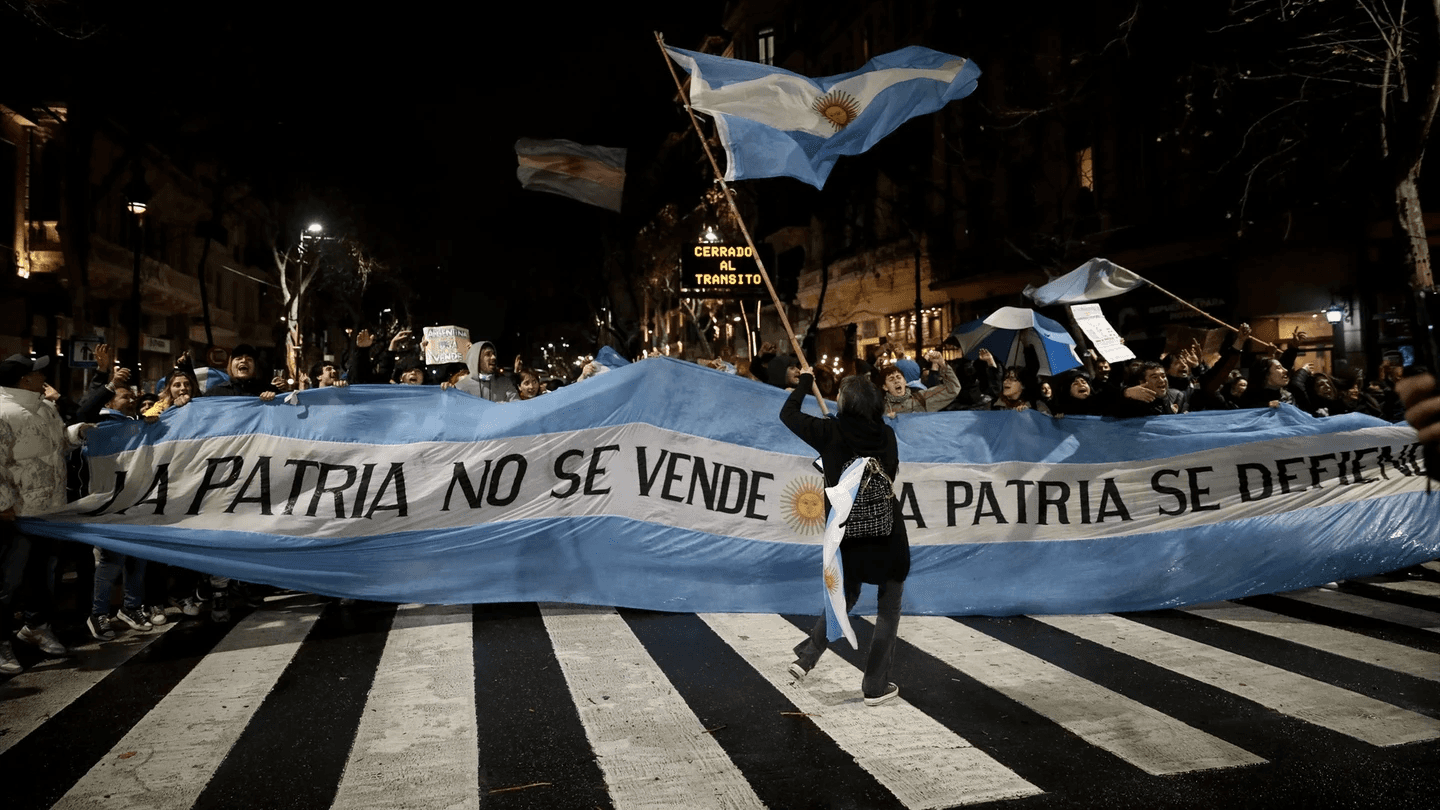
On the sixth of August, the Argentine Senate sat for more than ten hours, and outside the building the police turned water cannon on a crowd carrying a slogan that fit on one line: Argentina no se vende. Argentina is not for sale. Eleven people were arrested. Inside, the government of Javier Milei — the libertarian economist who has been president since the end of 2023, and who campaigned holding a chainsaw — won its Inviolability of Private Property bill, 37 votes to 33.
It won a hollowed version of it. The chapter that would have dismantled the country's land law — the chapter the crowd outside had come about — was withdrawn the day before for lack of votes. The chapter on wildfire protection went minutes before the ballot. So the government has its victory, and the law the victory was aimed at is still standing. Whether the night counts as a win depends on which of those two things you were watching. I was watching the second.
The Ley de Tierras, the 2011 statute that caps how much rural land foreigners may hold, has now survived a presidential decree, a federal court, and a Senate. The fight moves to the lower house.
I spent that afternoon reading the coverage, and what I kept thinking about was not a senator or a hectare or a percentage. It was a poet who never wrote a word about property law.
The poet
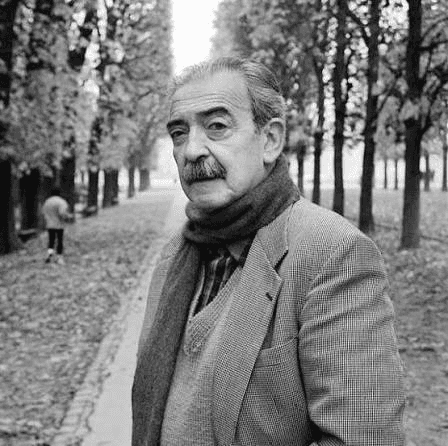
Juan Gelman is not much read in English, which is a shame and also the reason I have to introduce him. Within the Spanish-speaking world he needs no introduction at all: he won the Cervantes Prize in 2007, the highest honour in the language, the closest thing it has to a Nobel of its own.
He was born in Buenos Aires in 1930, the son of Jewish immigrants from Ukraine, and grew up in Villa Crespo among football and tango — which is worth holding onto, because the man I am about to enlist in an argument about who belongs to a country was himself the child of people who had just arrived in it. He published his first poem at eleven. He became a journalist. He refused, all his life, to accept the border between the intimate and the political, and wrote love and revolution, memory and disappearance, private grief and national wound as though they were a single subject, which for him they were.
In March 1976, the Argentine military seized power. Over the next seven years the junta abducted, tortured, and killed its opponents in secret; the standard figure for the dead is thirty thousand, and they are not called the dead. They are called los desaparecidos, the disappeared, because most were never returned and many were never found. The regime took infants too, delivered in clandestine hospitals and handed to military and police families to raise under new names.
Gelman was out of the country when the coup came, and his politics and his journalism kept him out for thirteen years. Five months after the tanks, in August of that same year, the regime took his son Marcelo, who was twenty, and Marcelo's wife María Claudia, who was nineteen and seven months pregnant.
He wrote in a language he had partly built himself: verbs invented out of nouns, diminutives carrying the weight of grief, lowercase where other poets would reach for capitals, and slashes chopping the line where a comma would have been too calm. The style is not decoration. It is a man who has lost the ordinary use of ordinary words and is assembling replacements.
I first read him on my balcony, on a Tuesday afternoon. The Tuesday is the least remarkable part of the memory and the part I have never been able to shake — an ordinary weekday, an ordinary hour, the afternoon going on around me exactly as afternoons do. On the page, a man was describing the loss of a son and the loss of a country. Off the page, nothing whatsoever was happening. I have thought since that this is why the poems work on Argentines the way they do: they arrive on balconies, on Tuesdays, in the middle of an unremarkable life, and inform you that the ground under that life was never guaranteed.
In 1990, he identified Marcelo's remains. His son had been executed and buried in a barrel filled with sand and cement. María Claudia's body has never been found.
Finding the grandchild took twenty-four years. In 1995, still not knowing whether the baby had been a boy or a girl, Gelman published an open letter to it in the newspaper Página/12. In 2000, after he had petitioned governments across two continents, the president of Uruguay confirmed that María Claudia had been taken across the river to Montevideo, had given birth there in captivity, and had been killed. The child had been handed to a police family. Her name is Macarena. She was raised under a name that was not hers, and when she learned the truth, she took her parents' surnames and became a human rights campaigner, and later a member of the Uruguayan parliament.
I put that story here because it is not background. It is the whole argument in advance. A chain was broken by force, a child inherited a false name, and an old man spent a quarter of a century trying to reattach the ends. Everything Gelman knew about inheritance he learned that way.
What the law actually says
Argentina's Rural Land Law, number 26.737, was passed in December 2011. It is narrower than either side usually makes it sound. Foreigners cannot hold more than 15% of rural land — nationally, but also province by province and municipality by municipality, which is the provision that actually bites. No single foreign nationality may take more than 30% of that 15%. No foreign owner may hold more than a thousand hectares in the prime agricultural zones. And one article, Article 10, bars foreign ownership outright where land contains significant permanent water or sits in a border zone.
"Foreign," here, means capital rather than passports: a company more than half foreign-owned, or controlled at a quarter, counts.
The Milei government has been trying to undo this since its first month. Article 154 of an emergency decree issued in December 2023 simply repealed the law. A group of veterans of the Malvinas — the 1982 war Britain calls the Falklands — took the decree to court, and there is something almost too neat about who stepped forward. In March 2024, a federal appeals court declared the repeal unconstitutional and sent the case up to the Supreme Court, where it still sits. The law has been standing on an injunction ever since. A subsequent government proposal would have gone further than the decree: limits kept only for foreign states and their agencies, and lifted entirely for private buyers, individual or corporate, with no ceiling at all.
Meanwhile, the numbers. Researchers at CONICET, the national science council, and the University of Buenos Aires counted more than 13 million hectares in foreign hands, nearly 5% of the national territory, an area about the size of England. Nationally, that sits well under the cap. But more than thirty departments have already passed it, and in a few — Lacar in the Andean province of Neuquén among them — foreign ownership runs above half. Since 2018 the foreign-held area has grown by roughly 6%.
That last set of figures is the honest heart of the matter, and it cuts in an inconvenient direction: the national total is modest, and the concentration is not.
What the law does not say
Which raises the question I should have answered before now, because it is the first one anybody sensibly asks: once the land is bought, is there anything the owner is not allowed to do with it?
Almost nothing that has to do with being foreign. Ley 26.737 is a gate, not a leash. It governs who may acquire rural land, and how much, and it keeps a register — the Registro Nacional de Tierras Rurales — of who ended up holding what. Even Article 10, the strictest thing in it, is a bar on acquiring water and border land, not a rule about conduct on it. Past the signing, a foreign owner is an owner like any other, with the same rights of use and disposal as the Argentine next door.
What limits use is the ordinary body of environmental law, and it applies to everyone equally: the 2007 native-forest law, which sorts forest into protection categories and forbids clearing in the strictest of them; the 2010 glacier law, which puts mining and hydrocarbons out of bounds on glaciers and the frozen ground around them; provincial water and land codes. And here a constitutional detail matters more than any single statute. Since the 1994 reform, natural resources belong to the provinces rather than the nation, which means the rules governing what actually happens on a Patagonian estancia are largely written and enforced by a provincial government whose budget usually depends on attracting the very investment it would be policing.
Which is why the wildfire chapter that vanished minutes before the vote was not a side matter. The provisions at stake bar burnt land from being reclassified and built on for decades after a fire — roughly, the rule that stops a burnt forest from becoming a subdivision. Ownership rules decide who holds the ground. Use rules decide what the ground is still capable of when it is handed on. This essay is about the second, and the second is by far the weaker of the two.
The case for opening it up
I want to state the other position properly, because it is not frivolous, and pretending otherwise is how essays like this one get ignored.
Argentina needs capital. After decades of inflation, default, and capital flight, it needs infrastructure and productivity and someone willing to put money into ground that is sitting idle. A foreigner who buys an estancia — a ranch, often an enormous one — does not carry it off; the land stays inside the jurisdiction, and so do the courts, the tax authority, and the police. The 15% cap is a blunt instrument that treats a Chilean neighbour buying two hundred hectares exactly as it treats a sovereign wealth fund. And there is something genuinely uncomfortable about a country assembled almost entirely out of arrivals deciding that arrivals are the risk. Between 1870 and 1930 Argentina took in something on the order of six million immigrants, and by the 1914 census roughly a third of the people in the country had been born somewhere else. Most of us here descend from someone who got off a boat with a suitcase and no claim to this place whatsoever. Gelman's parents did.
All of that is true. None of it tells you where the limit should be, or whether there should be one, because those are not economic questions and calling them economic does not make them so.
What Gelman gives us instead
Writing from exile, he named one of its obligations:
"no olvidar el exilio / o sea la tierra / o sea la patria"
Not to forget exile, which is to say the land, which is to say the homeland.
The argument is in the repetition. O sea — "that is to say" — is what people say when they are correcting themselves mid-sentence, reaching for a more accurate word. Gelman reaches twice, and the terms fall into one another: exile becomes land becomes patria, and the poem declines to hold them apart.
Patria is the hinge of this whole essay, and English does not really have it. "Homeland" is too close to the state and carries a faint whiff of security ministries; "fatherland" is worse. In Spanish the word is warmer, more domestic, and much older than any particular government — it is the thing you are from, and it survives every regime that claims it. That distinction is doing all the work here. The patria is not the state. Not a government, not a flag, not an ideology, none of which Gelman had any reason to love. It is memory fastened to a place.
Which brings me to the far end of the country.
Patagonia
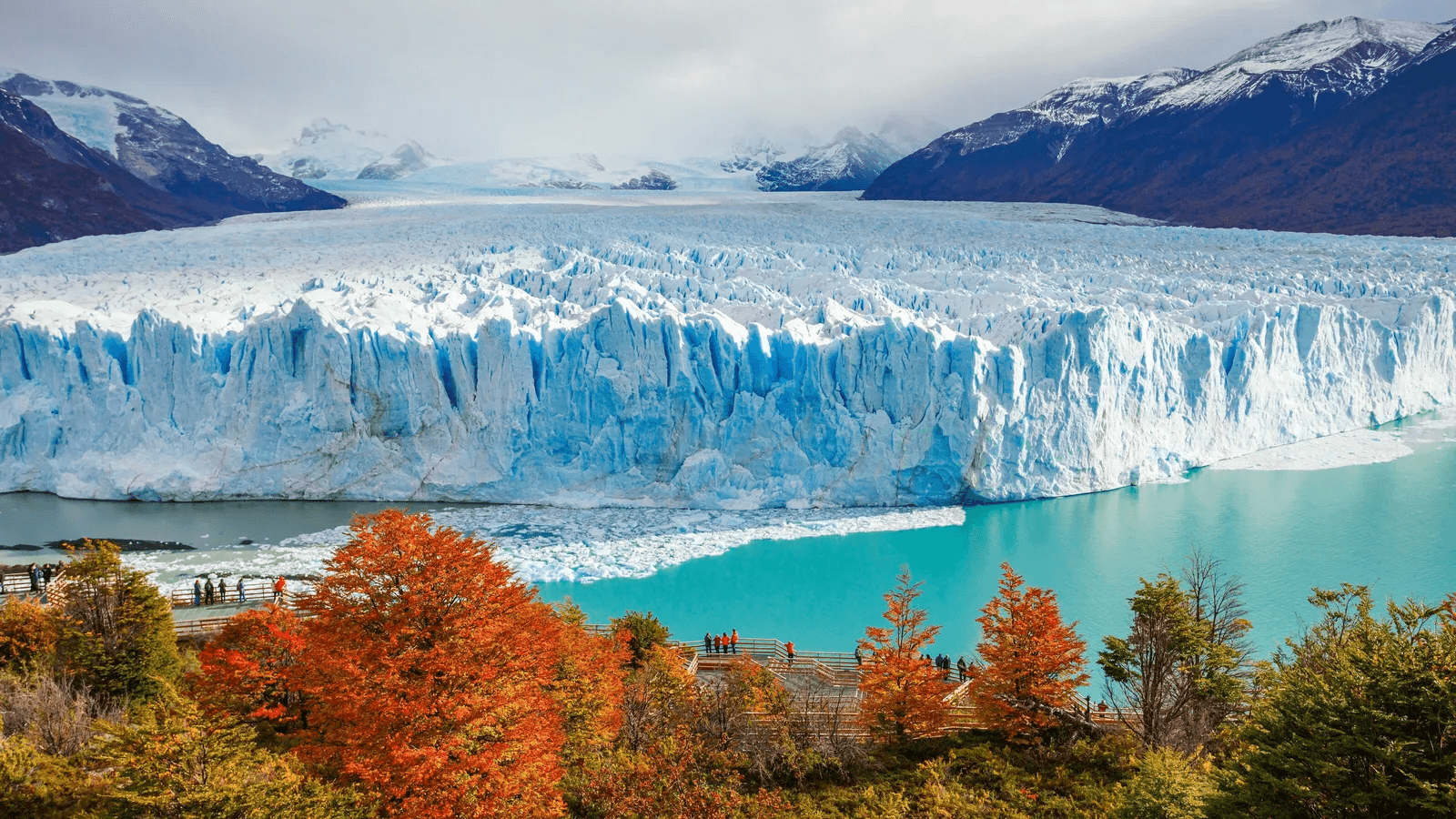
For readers who have never been: Patagonia is not a park or a region in the European sense. It is close to a third of Argentina's landmass, holding something like five per cent of its people — steppe and wind for hundreds of kilometres, the Andes and their lakes down the western edge, sheep country, oil and gas, glacial fresh water, and a long southern border with Chile. Ushuaia, at the bottom, is the southernmost city in the world, three thousand kilometres from Buenos Aires, which is farther than London is from Cairo.
A Patagonian valley can be assigned a number. So can a forest on a lakeshore, a river basin, an Andean estancia, three hundred thousand hectares running toward the frontier. Markets are excellent at establishing what someone will pay. What no market can tell you is whether everything capable of being bought should be available without limit.
I have stood on one of those glaciers. I went to Ushuaia one Christmas — high summer in the southern hemisphere, the longest light of the year — and on the ice it began to snow, and I cried. I am not going to explain that, mostly because I can't. What I kept was the incongruity of it: the end of the country, December, snow coming down on people dressed for summer, and not one part of the arrangement aware of us or arranged for us.
Someone could buy that. Not the snow, but the ground it was falling on, the water underneath it, the road up. There is a number that would do it, and somebody has almost certainly already run it. I don't think the number is wrong, exactly. I think it answers a different question from the one I was inside of on that ice. A price answers what will somebody pay for this. Standing in the snow I had no question at all, only the sense of being very small in front of something that had not been arranged for me — and a price has nothing to say to that, in either direction. It is also, as it happens, precisely the kind of frontier that Article 10 was written around.
Gelman wrote elsewhere:
"No debiera arrancarse a la gente de su tierra o país."
People should not be torn from their land or country.
He was writing about exile, not foreign investment, and it would be dishonest of me to let the two blur. A pension fund buying in Neuquén is not a junta putting a poet on a plane, and any argument that needs that equation is a bad argument. But the intuition underneath the line survives the change of context. Arrancar is what you do to a plant: you pull, and the roots come up with it. The verb assumes an attachment that ownership law has no vocabulary for. Land holds memory. It gives the abstract word patria something physical to hold onto. Losing your grip on it is a different order of loss from losing an ordinary possession.
Patagonia is not valuable only because it is beautiful. It holds water, forest, minerals, arable capacity, ecosystems, and frontier the state has always treated as strategic. The existing law already knows this, which is why its heaviest restrictions fall on water and border rather than on rural land in general — and why fire and burnt-forest provisions ended up tangled in the same bill this month, after a season of Patagonian wildfires. These things are being argued about together because they are, in fact, one question.
The part that complicates my own argument
If I am going to talk about inheritance, I have to say who was disinherited.
Most of the Patagonian land now bought and sold was taken by the Argentine state within the lifetime of the republic. Between 1878 and 1885 the army ran the campaign it called the Conquest of the Desert — the desert in question was not empty — and the Mapuche and Tehuelche who lived there were killed, marched north, or distributed to families in Buenos Aires as servants. The estancias whose foreign ownership we are now debating were carved out of that. The Welsh who built their chapels in Chubut in 1865 arrived before the army did. Almost everyone else arrived after, onto ground the army had cleared.
This does not dissolve the argument, but it changes its shape. It means "inheritance" cannot be a claim about ancestral right, because ours is short and bloody and barely a century and a half deep. It has to be a claim about obligation forward rather than title backward. That is a harder thing to say and a better one. It is also closer to what Gelman meant. He was never a poet of ancestral soil. He was a poet of interrupted chains, of the thing that was supposed to continue and did not.
The harder patriotism
His patriotism is worth something here precisely because nothing about it was easy. He had every reason to be finished with Argentina. The state persecuted him. A dictatorship killed his son and took his granddaughter. He spent thirteen years on other people's streets, in Europe, then the United States, then Mexico, where he died in 2014 without ever moving home. And still:
"Te amo patria y me amás."
I love you, homeland, and you love me.
Six words, and the second clause is the astonishing one. He does not only love the country; he insists the country loves him back — the same country whose army had just destroyed his family. That is not patriotism in its comfortable form, and it is not the patriotism of believing your country innocent. It is attachment that survives full knowledge. You love the place while knowing exactly what it has done, because its language and its dead and its streets have become inseparable from what you are.
That register is missing almost entirely from the argument we are actually having — the argument over whether, and how far, foreign buyers should be allowed to acquire Argentine rural land, Patagonia above all. One side speaks in property rights, investment, and growth. The other speaks in sovereignty and betrayal. Both are political vocabularies, and neither has any way of saying that a country is a thing you are attached to.
The mountains do not know they are Argentine. The glaciers have no nationality. The wind coming across the steppe does not recognise a border, and nature is entirely indifferent to our maps.
We are not. We inherit the maps from people we never met, hold them briefly, and hand them to people we will never meet either. That is what makes territory unlike other assets: it is less property than inheritance, and inheritance carries obligations that a title deed does not.
There is one line of his that has never left me. It sets a country beside its own damage and lets them turn out to be the same thing:
"Cuando el dolor se parece a un país / se parece a mi país."
When pain resembles a country, it resembles mine.
Argentina should not need loss in order to recognise value. It can take the capital and keep the ceiling. It can invite the world in without concluding that everything inside the border is therefore for sale. What it cannot do — what the vote on the sixth of August only postponed — is keep pretending this is a question about investment climate, when it is a question about what we intend to hand over, and to whom, and in what condition.
Inheritance was always the wrong word, or the right word used honestly. We did not inherit Patagonia. We took it, and so recently that the names of the people we took it from are still sitting on the map — Lacar, Neuquén — in the places where foreign ownership now runs past half.
So the obligation cannot run backward to an ancestral claim we do not have. It runs forward: to people not yet born, the dispossessed among them, who will inherit the map in whatever condition we leave it. Gelman spent twenty-four years trying to repair one chain that had been broken by force, and he only ever got one end of it back. We are currently deciding whether to break another by contract instead.
Image Sources:
https://www.lasexta.com/noticias/internacional/miles-argentinos-protestan-buenos-aires-ley-propiedad-privada-lema-patria-vende_202608076a75807371b42a0b5de143c2.html
https://www.cultura.gob.ar/juan-gelman-10458/
https://www.nationalgeographicla.com/viajes/2024/10/los-4-lugares-de-la-patagonia-argentina-que-son-patrimonio-de-la-humanidad


