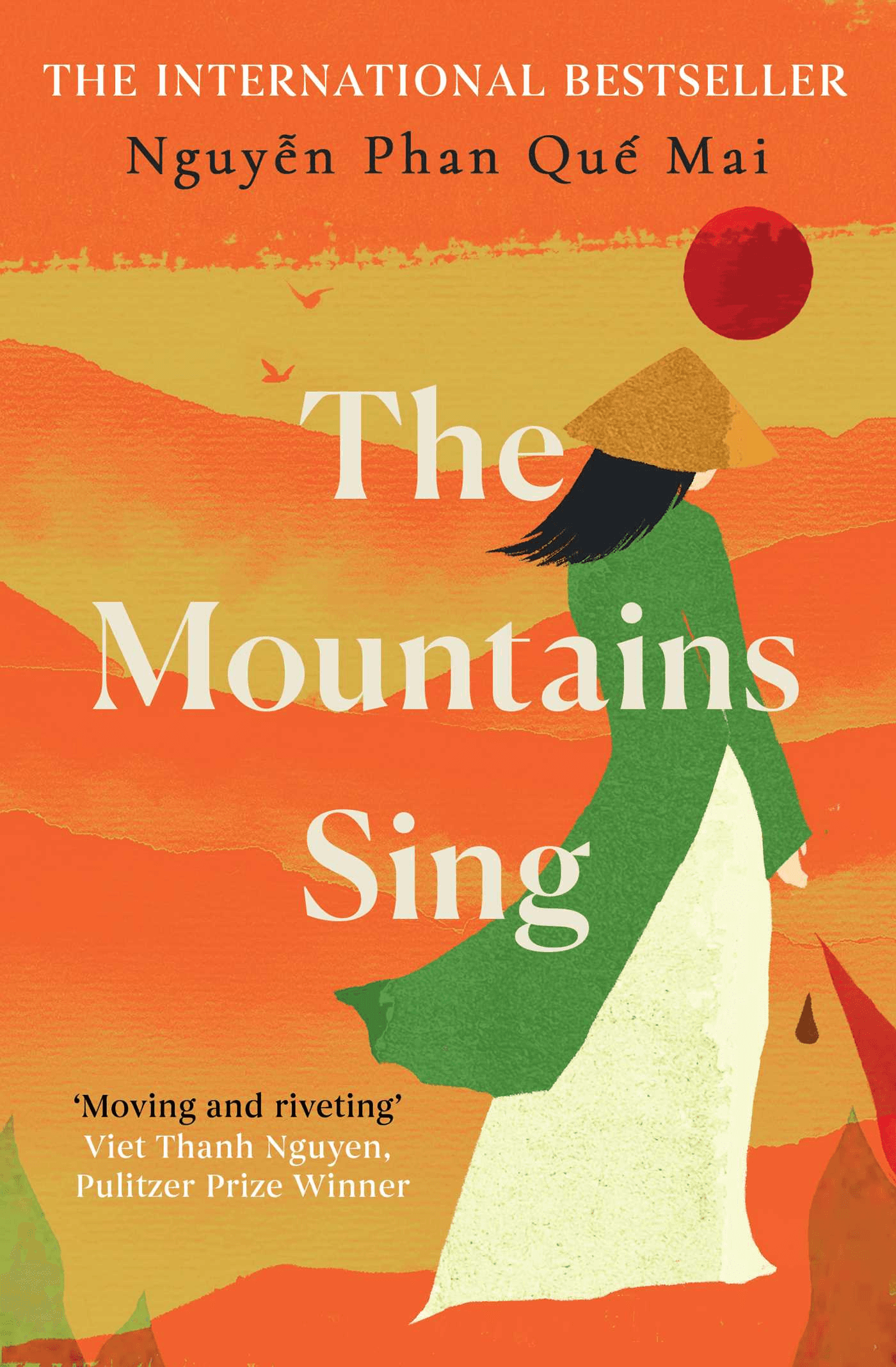


“I realized that war was monstrous. If it didn’t kill those it touched, it took away a piece of their souls, so they could never be whole again.” — The Mountains Sing, Nguyễn Phan Quế Mai.
We often measure wars by casualties, battles won, and borders redrawn. But the deepest scars are rarely visible on maps. They live in families—passed from grandparents to parents to children through stories, silence, loss, and memory. I’ve just finished reading Nguyễn Phan Quế Mai’s historical fiction novel, The Mountains Sing, which tells the story of this inheritance of war through one Vietnamese family whose lives are shaped by decades of conflict, from the aftermath of World War 2 to the Vietnam War. Spanning decades of Vietnamese history—from the Japanese occupation and the devastating famine of 1945, through land reforms, the Vietnam War, and the difficult years that followed— Rather than focusing on the battlefield, the novel turns our attention to kitchens, rice fields, family altars, and whispered conversations between grandparents and grandchildren. It reminds us that wars do not simply destroy nations; they reshape families, alter identities, and echo long after peace treaties are signed.
One of the novel’s most powerful themes is the role of family stories in preserving identity.
“Do you understand why I’ve decided to tell you about our family? If our stories survive, we will not die, even when our bodies are no longer here on this earth.”
For families forced to flee their homes, stories often become the only things that cannot be taken away. They preserve language, culture, and belonging when home itself has been lost.
Although deeply rooted in Vietnam’s history, its message is profoundly universal. Today, millions of families from Sudan, Palestine, Syria, Afghanistan, Somalia, the Democratic Republic of the Congo, and countless other places continue to navigate the same painful realities: displacement, separation, grief, uncertainty, and the struggle to preserve memory in the face of unimaginable loss.
Throughout The Mountains Sing, home is never guaranteed. Homes are abandoned, confiscated, destroyed, or left behind in search of safety. For the family at the center of the novel, displacement is not a single event but a recurring reality that defines multiple generations. Displacement is often imagined as a physical journey—from one country to another, from one refugee camp to the next. But the novel illustrates something deeper: losing home also means losing familiarity, routine, community, language, and a sense of belonging.
For millions today, this remains painfully true. Families fleeing violence in Sudan leave behind neighborhoods where generations once lived together. Palestinian families have endured repeated displacement across decades, carrying house keys that no longer open any doors. Syrians continue rebuilding lives in countries far from the places they once called home. Afghan families have navigated decades of conflict that have repeatedly forced them to leave everything familiar behind. In eastern Congo and Somalia, conflict has displaced entire communities multiple times over.
The politics surrounding these conflicts differ significantly, and each has its own unique history. Yet the human experience of displacement often feels strikingly similar: parents trying to reassure frightened children, grandparents mourning the homes they may never see again, and young people growing up between memories of one country and realities in another.
I feel this so deeply. As a young Sudanese who has never lived in Sudan, I have always considered it home through the stories, memories, and love passed down by my family. Watching my loved ones flee their homes, and seeing my grandparents face the heartbreaking uncertainty of whether they will ever return, has made me understand that the true cost of war extends far beyond the battlefield. It fractures families, uproots generations, and leaves people mourning not only what they have lost, but the future they imagined.
Near the beginning of the novel, readers encounter an image that captures its central message:
“The challenges faced by Vietnamese people throughout history are as tall as the tallest mountains. If you stand too close, you won’t be able to see their peaks. Once you step away from the currents of life, you will have the full view.”
The mountains are more than a landscape. They symbolize endurance. They witness wars come and go while generations rise, suffer, rebuild, and continue living.
Today, families across the world continue climbing mountains of their own. Some carry memories of villages that no longer exist. Others carry photographs of loved ones they have lost. Many carry hope that their children will inherit something more than conflict. The Mountains Sing reminds us that while wars may begin with governments and armies, they are lived most intimately within families. Long after the headlines fade and the treaties are signed, parents still comfort their children, grandparents still preserve memory through stories, and communities still rebuild what violence tried to erase.
Perhaps this is the novel’s greatest gift. It asks us to see beyond maps and military campaigns, beyond statistics and political rhetoric, and to recognize the quiet resilience of ordinary people. For when homes are lost, stories become homes. When history forgets, families remember. And when the guns finally fall silent, it is those memories—and the people who carry them—that continue to shape generations.
this article was previously published on Sarya's substack
https://saryafarah.substack.com