

I used to believe that my generation would change the way the world responded to humanitarian crises. We grew up with something previous generations never had: instant access to almost everything. Wars, displacement, famine, and injustice could reach our screens within seconds. I thought that seeing more would naturally make us care more.
As an Iraqi, I grew up watching my country appear in the global news through a succession of intense images: the fall of Baghdad, the toppling of Saddam Hussein’s statue, his execution, years of bombings, and later the rise of ISIS. Each moment briefly placed Iraq at the centre of international attention. Then the cameras moved elsewhere, while Iraqis continued living with displacement, insecurity, and the long consequences of war. Years later, I realised that many people still recognised Iraq mainly through those same images, as though the country had remained frozen inside them. The attention had faded, but the image had not.
That realization made me question something much bigger than my own experience. Even when a country receives global attention, it often fades long before people have truly understood its reality. What happens to people whose suffering never becomes part of the global conversation, or disappears before the world has time to truly understand it?
The more I thought about it, the more I questioned the way we respond to crises today. A tragedy unfolds, millions share it, and a hashtag spreads across social media. For a brief time, it feels as though the whole world is watching. We saw this with the black squares shared for Black Lives Matter and with profile pictures changed to the Ukrainian flag. These gestures can express genuine solidarity, but sometimes they also become a way of joining the moment rather than staying committed to the people behind it. Then another crisis appears, the hashtag disappears, and so does our attention, even though the suffering continues. Does constant exposure make it easier for us to move on? Maybe our greatest challenge today is not that we fail to see suffering, but that we fail to stay with it.
Beyond the Headlines
Sudan made that lesson impossible to ignore. Since April 2023, Sudan has been caught in a devastating conflict between the Sudanese Armed Forces and the paramilitary Rapid Support Forces, turning a struggle for power into one of the world’s largest humanitarian crises. Millions of people have been forced from their homes. Families have crossed borders carrying whatever they could save. In many areas, hospitals, schools, and essential services have collapsed, while hunger and insecurity have become part of everyday life. Women and girls have faced some of the highest risks, including conflict-related sexual violence, displacement, and limited access to medical care and protection.
Sudan is not alone. In Myanmar, families continue to flee violence years after international attention faded. In the Democratic Republic of the Congo, generations have lived through conflict and displacement without receiving sustained international focus. Different countries and different histories, yet the same pattern remains: the crisis continues long after the world’s attention has shifted elsewhere.
One thing became increasingly clear to me: when a crisis remains unresolved for months or years, it slowly stops being treated as an emergency. The suffering does not become smaller; it simply stops feeling exceptional. Humanitarian organizations struggle to maintain funding, political pressure weakens, and calls for action become quieter. Yet none of this changes the reality for the people still living through the crisis. Their lives do not pause because the headlines have.
What affects me most is how easily human lives can become abstract once an emergency stops feeling immediate. Millions displaced. Thousands killed. Entire communities left without food or healthcare. We read these figures, but the people behind them can slowly disappear from our imagination. They become numbers attached to distant places such as Myanmar and the Democratic Republic of the Congo, rather than people whose lives have been interrupted, whose families are still waiting, and whose futures remain uncertain.
Being forgotten creates another kind of loss. People do not only lose homes, safety, and loved ones; they can also lose their place in the world’s memory while they are still struggling to survive. This is not a new pattern. Long before social media, entire communities and regions were pushed to the margins of global attention, often remembered only after the damage had already been done. Many of the same minorities, displaced populations, and conflict-affected regions remain the easiest to overlook.
After We Look Away
I once thought the greatest danger was that people would never know these tragedies existed. Now I wonder if a different danger is just as serious: that we know they exist, yet slowly stop being surprised by them.
The more I sat with these stories, the more uncomfortable my questions became. There is a difference between witnessing suffering and staying with it. We can read about a crisis, share it, talk about it for a while, and sincerely care. But real care asks more from us than emotion or awareness. It can require sacrifice, uncomfortable choices, and a willingness to let distant suffering influence how we act, what we support, and what we refuse to ignore. Yet care becomes fragile when it depends on what everyone else is looking at. The moment the spotlight shifts, our emotional connection often shifts with it.
Thinking about these stories did not leave me with answers. Instead, it changed the questions I ask. What do we owe people whose suffering we witness from a distance? Is solidarity measured by how quickly we react, or by whether we are still willing to remember when the rest of the world has already moved on?
Long after the hashtags disappear and the cameras leave, families are still searching for safety. Children are still growing up in uncertainty. Entire communities are still trying to rebuild lives that never stopped needing the world's attention.
Maybe that is what "All Eyes On …" should really mean.
Not looking for a moment.
But refusing to look away too soon. Perhaps real solidarity begins when we stop thinking of conflict as something that happens only to "other people." Distance can create the illusion that suffering belongs somewhere else, to someone else. Yet recent years have shown how quickly war and displacement can reach places once considered safe. Maybe the real challenge is to see their lives not as separate from ours, but as lives that could have been ours.
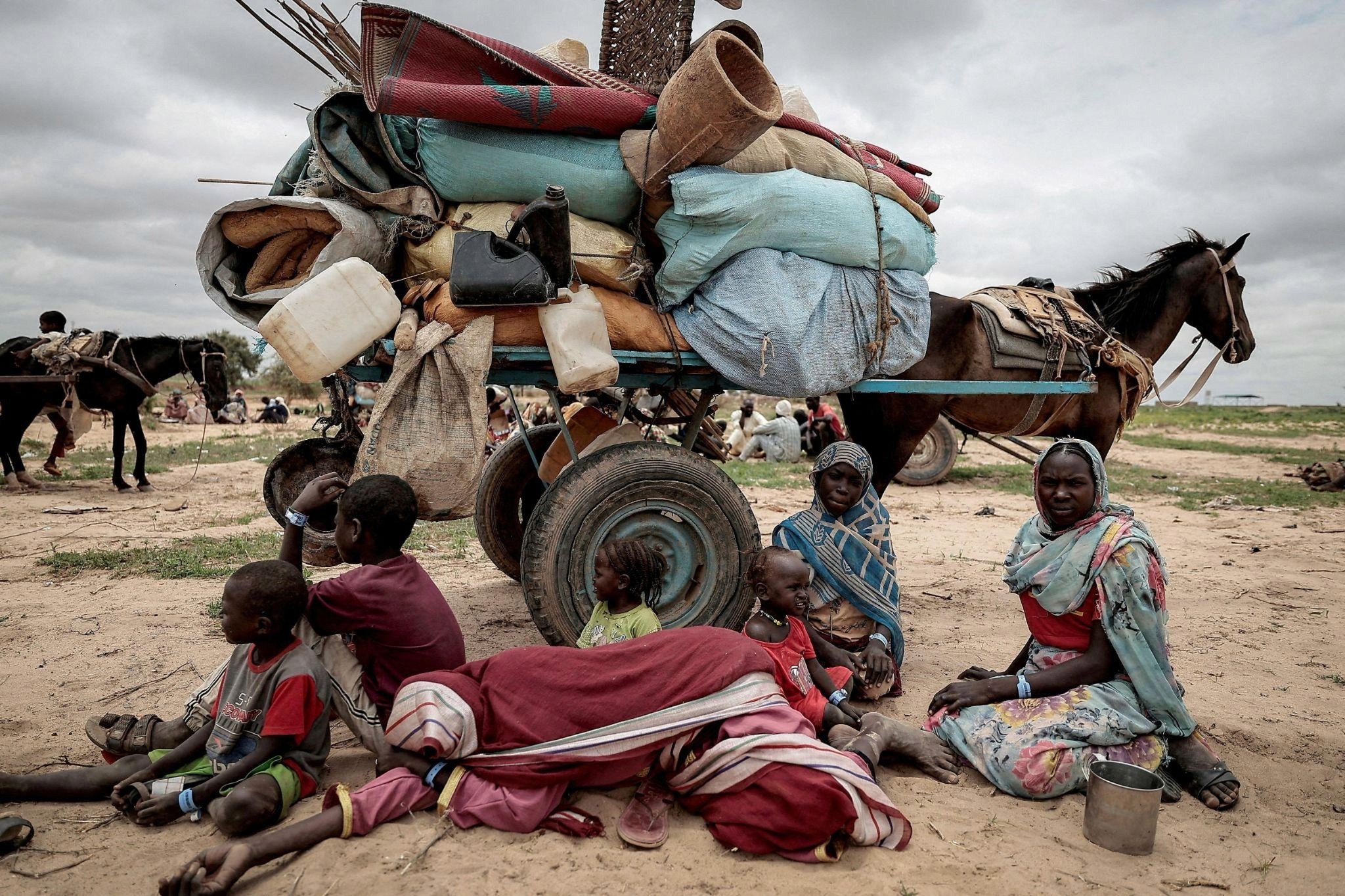
Sudanese civilians displaced by the conflict gather near the Chad border after fleeing violence in Darfur, Sudan, July 2023.
Photo: © Zohra Bensemra / Reuters.
Works Cited
United Nations High Commissioner for Refugees. Sudan Emergency. UNHCR, Sudan emergency | UNHCR . Accessed 1 Aug. 2026.
United Nations High Commissioner for Refugees. Myanmar Emergency. UNHCR, Myanmar emergency | UNHCR . Accessed 1 Aug. 2026.
United Nations High Commissioner for Refugees. DR Congo Emergency. UNHCR, DR Congo emergency | UNHCR . Accessed 1 Aug. 2026.
United Nations Population Fund. “I Witnessed Unimaginable Horrors”: Sexual Violence Used as a Weapon of Terror against Women and Girls across Sudan. UNFPA, 2 Apr. 2025, “I witnessed unimaginable horrors”: Sexual violence used as weapon of terror against women and girls across Sudan | United Nations Population Fund .
Reuters. Refugees Flee Sudan’s Darfur to Chad. Photographs by Zohra Bensemra, 25 July Refugees flee Sudan's Darfur to Chad - July 25, 2023 | Reuters .


