

Consider these pages a postcard from Mauritius—an island often remembered for its turquoise lagoons and beige beaches. Yet, the sea has given us more than just its beauty. It brought together diverse people as labourers, traders, migrants and slaves from Africa, Asia and China. With no indigenous population, each one of us arrived from somewhere else, forming an exquisite cultural cacophony. That is perhaps why our ocean feels less like a simple milieu, and more like an open shared archive. The stories in this essay are all fragments of that larger history, and however ordinary the encounters are, each one echoes one word: Mauritian—as one people, as one nation.
Entering the Water
There exist few places where conversations seem irrelevant and unnecessary. One of them is the sea. You enter the water alongside strangers, all with different walks of life, and move in silence once submerged. Your words dissolve in a blur as the sound of water fills your ears and your body tugs at the currents. I did not think of any of this when I began swimming more often this semester. It was merely a way to clear my head after long classes and socialising. The repetitive strokes, steady calculated breaths, and the feeling of weightlessness quieted my noisy mind, something that felt increasingly hard to find elsewhere. Badminton, track and field, pilates or dance classes all failed for me.
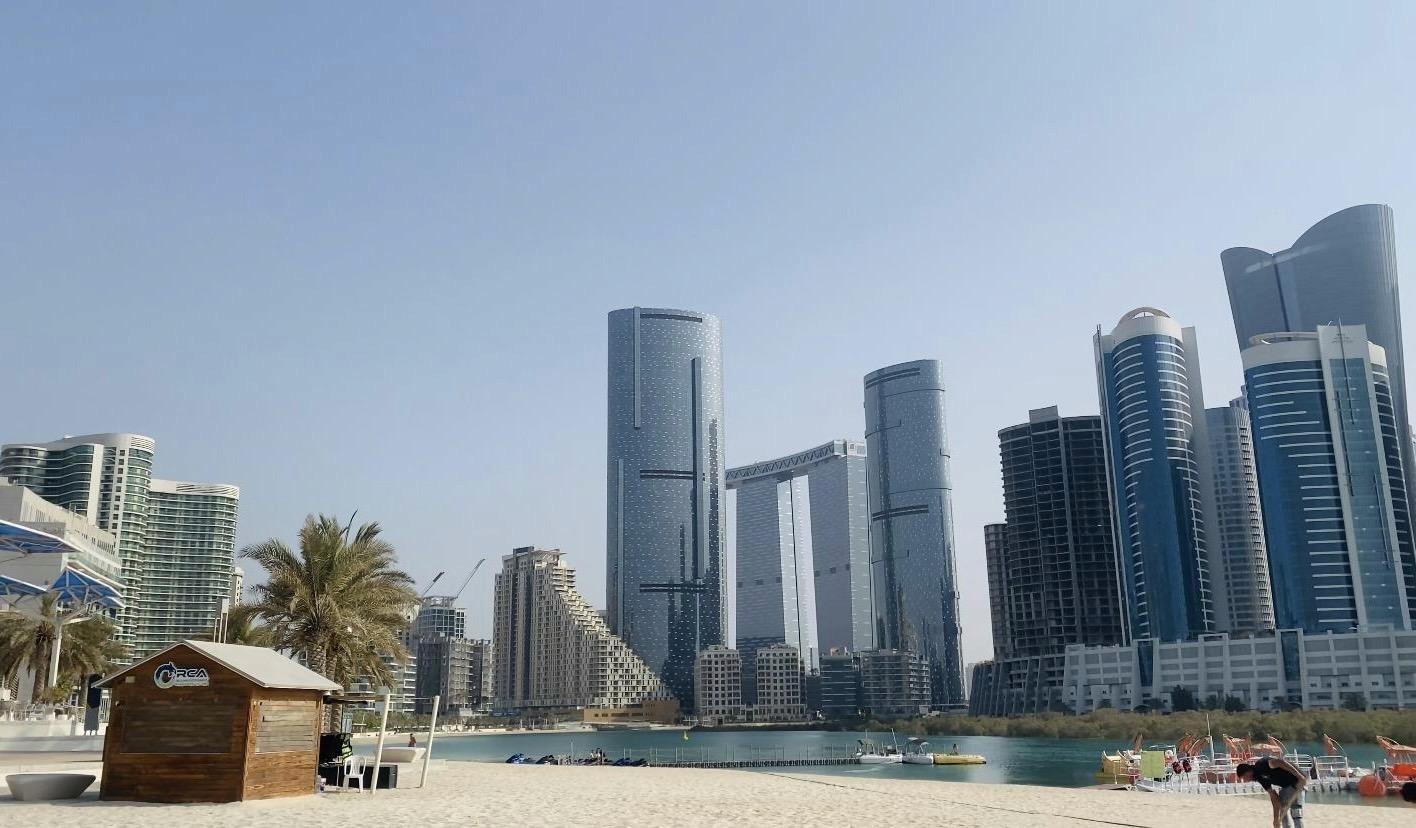
During the first semester, swimming and the person I was back in Mauritius felt like a ghost. Life in Abu Dhabi was a cacophony of rigid schedules and new routines that left no room for leisure. I had lost my inner ‘mermaid’. Then came a warm spring afternoon at Reem Central Park: the city quieter than usual, the light dimmer and the coast lined with mangroves enhanced the horizon. I rented a paddle surfboard out of curiosity, trying to regain a balance I had previously taken for granted. From the board, Abu Dhabi appeared distant and slightly distorted by the sun’s glare. Once far off shore, I started to subconsciously compare and contrast between my two islands - Reem and Mauritius. The water was hotter than in Mauritius, its warmth wrapping around my body in a way that felt almost heavy. It was also saltier, leaving a sharper taste at the back of my throat whenever I surfaced too quickly. The seabed was rough, scattered with coarse sand and broken shells that pressed unevenly against the soles of my feet. Each sensation reminded me that although I was swimming again, I was not in the ocean I had grown up with.
A Conversation with Someone Far from Home
That afternoon, I floated again. The water’s silence, punctuated only by distant laughter and the clumsy splash of a paddleboarder, felt both strange and familiar - like hearing a language you are fluent in but didn’t use in years. Or like driving a manual transmission car after using an automatic for what felt like ages. As my two hour long session was almost concluding, I felt my left leg cramp, one of the worst I’ve ever experienced. I blinked and found myself upright in the water and far from the board - unable to tread the water with the pain. There was nothing to hold on to. Is this the end? You might be wondering where my safety jacket was. I left it on the board, too confident in my mermaid skills. The salty water burned my nostrils down to my throat as I struggled to not drown. My body was giving up, and just in the nick of time, a man pulled me on his motorboat. I presume that was the lifeguard. The first twenty minutes was one of the worst feelings I have experienced: a mixture of nausea, coughs and burning down my throat with a headache.
And that’s how I encountered Khalid, a migrant from Pakistan, Sialkot. We got acquainted not long after, which challenged my initial beliefs about conversations at sea. He spent most of his day walking back and forth across the sand, pausing now and then to adjust a sign or call out a warning to someone drifting too far from the designated zone. When I told him I was Mauritian and only in Abu Dhabi for my studies, his expression softened slightly, as if the idea of being temporarily displaced was something he understood well. Conversing in Urdu amplified this understanding. He had been working in the UAE for several years, moving between construction sites and service jobs before becoming a lifeguard. His shifts, he explained, often lasted at least twelve hours, especially during spring and winter.
The scenery was serene yet his posture remained tense, with a constant need to anticipate accidents before they happened. He also shared that he dreamt of swimming for the Olympics but never got the chance to do so as he had a family to feed and sick parents to look after. So, he feels accomplished by being in this environment, his panacea. Standing there, I became aware of how differently the same stretch of sea functioned for each of us. For me, returning to the water marked a small personal reconnection, a way of reclaiming something I had unknowingly abandoned during the fall semester. For him, it was his job and the remedy to the pain of his unrealised dreams. I left with my skin tight with dried seawater and my arms pleasantly sore from rowing the paddleboard. And as my inner swimmer woke up, the NYUAD swimming pool started seeing me almost daily.
Back to Familiar Waters
Months later, back in Mauritius, the water felt entirely different. At Blue Bay, the sea carried a faint scent of salt and seaweed, but felt ever so alive. Three thousand miles from the people and places I called home, and buried under a mountain of assignments, I turned to the sea for the comfort I craved. I started going earlier than usual. This was not intentional; my body got accustomed to waking up before sunrise during my time away—partly to cherish the serenity before the world wakes up.
A Conversation before Sunrise
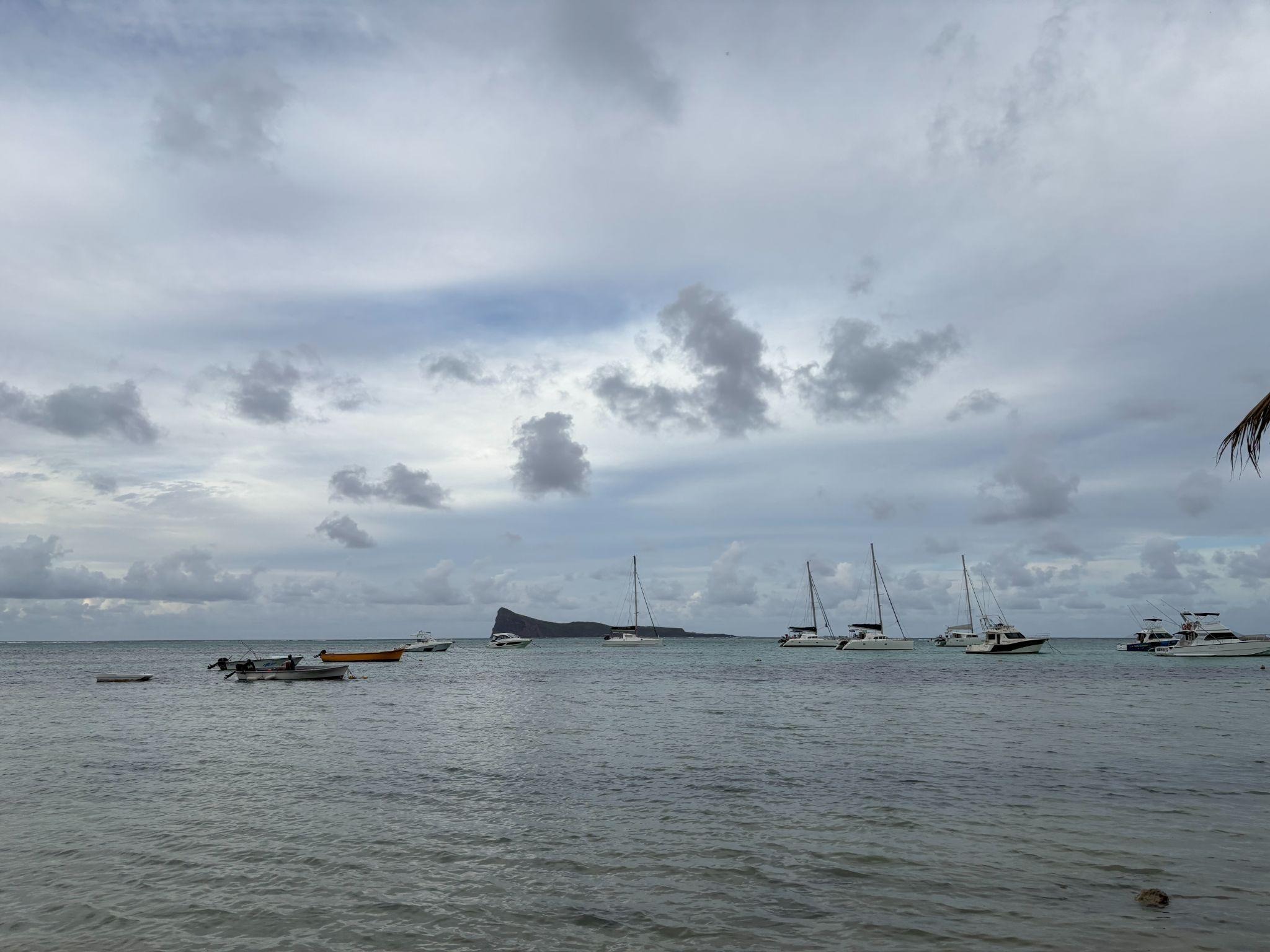
At five in the morning, the beach belongs to the workers—coastguards and in particular, fishermen. That was when I encountered Rajen, standing ankle-deep in the water beside a narrow wooden boat in a fading red paint. His fingers were working to gather the fishing net, packing to go home. I must have been standing and glaring for longer than I realized, without meaning to, of course when I heard “to pou ale nager la?” (are you going to swim?). And that’s how we started talking. By the time I arrived each day, his work was already done. The fish sorted, some kept, some sold, some too small to matter. The nets rinsed just enough to be used again later. He gave me small slices of his life while he was getting ready to leave—tying something here and there. His day starts at 3.30 a.m—he emphasized with pride that unlike the youth today, he required no alarm clock; he had a built-in alarm clock. He has never been even one minute off the dot. When I asked him what helped him stay consistent for 50 long years, I got a simple answer: “Travail gramatin pou manze tantot” (work in the morning to feed yourself at night).
“All I have is this,” he said, tapping the side of the boat with his arm. His father had passed it down to him and for as long as he could remember, fishing had been a constant through generations. I was curious whether he is passing down this craft in our modern 2026. His face frowned a bit, I touched a sensitive spot it seemed. “Mo garson dans lot travail aster,” he said, his son quit for another job now. He jumped in the sister industry—the hotel industry where he’s a bartender. The silence after this sentence said a lot. It was maybe a salary that was in the hands of the sea, the weather and the early mornings. I collected more slices of his life over time. Rajen was somewhat of a jack-of-all-trades: a swimmer, a first-aider, a carpenter, you name it. Years ago, he recounted the experience of rescuing a man who had stepped on a stonefish. To keep in mind that the nearest hospital back then was hours away and cars were not common in all driveways. Rajen and another fisherman had gone out immediately, pulling him on their boat. He described that the pain was moving through the man faster than they could keep up. But that day, they ended up saving his life, and countless others like him over time. Yet, fishing was not always heroic and promising. Sometimes, it looked like sleeping on an empty stomach because the sea is not in your favour that day—due to cyclones or torrential rains which are common in summer. He spent his life at the mercy of the currents, with the mentality that the sea does not owe people anything. By the time we shook hands in goodbye, the beach started welcoming its visitors. The same private space now turned public. I walked back to my car—reflecting on our last handshake and heart-touching memories. Those hands were rough in a way foreign to me, not just calloused but slightly cracked with the salty water, rough ropes, and sun.
A Conversation about Fear
A new dawn. Fragments of different languages, flippers dragging across the sand and lifejackets made their way into the scene. The day’s mission was snorkeling—swimming face-down while breathing through a tube called a snorkel with the hope of observing the rich marine life. The instructor explained the in-and-outs of this activity to the whole group prior to starting. I got paired with Katja, a Norwegian woman who was attempting to challenge her fear of being underwater on that day. She kept lifting her head every few seconds to adjust the mask that was pressing too harshly against her face. She hated the feeling of breathing through the tube. “I feel like I am not getting real oxygen and feel trapped,” she laughed awkwardly, before dipping for a few seconds again. For me, being in the water was liberating, trapped was too weird of a description. The way water lets you glide in it, float on its surface, cool your skin with some splashes. You become a water-bender by default. It took her some time to adjust to the equipment. Everyone takes time to adjust—be it new shoes, new glasses or even a new phone. Half an hour later, we were relishing the colorful marine life: bright vivid fish, sculpted corals that resembled art, green algae contrasting with the warmer colors. The speciality of snorkeling is that you always see new things. It’s like a movie that is always refreshing, you never get tired of it. The closeness with the marine animals comforts me in a unique way. You cannot pet them as they always maintain this safe distance. You admire them and they admire you back. It is this subtle, almost inexistent connection that keeps me coming back. The philosopher in me thought of writing a few lines on this ‘safe distance’ that marine animals in the sea are sworn to. Do fish have thoughts? How close is too close? Is too close equivalent to too dangerous or simply mild discomfort for them? Could humans ever replicate this ethos voluntarily? Boundaries are, in fact, ubiquitous. “C’mon guys, let’s wrap up,” the instructor snaps my trance. I always get confused as to how time just flies in the water—is the water a time machine? As we approached the shore, it got colder. You can feel the breeze cooling the water droplets on your body. The only part about being in water that yields some discomfort. Katja and I exchanged numbers, in hopes of doing this again. For her, it was a victory against her fear of being entirely submerged. “It was really nice to have your company, I don’t think it would be as easy on my own,” she thanked me. That was the highlight of my day. If college doesn’t work out, I might just start my swim school (just joking). People do famously say that if you love what you do, you won’t work a day in your life. Let’s keep this as a side hustle idea for now.
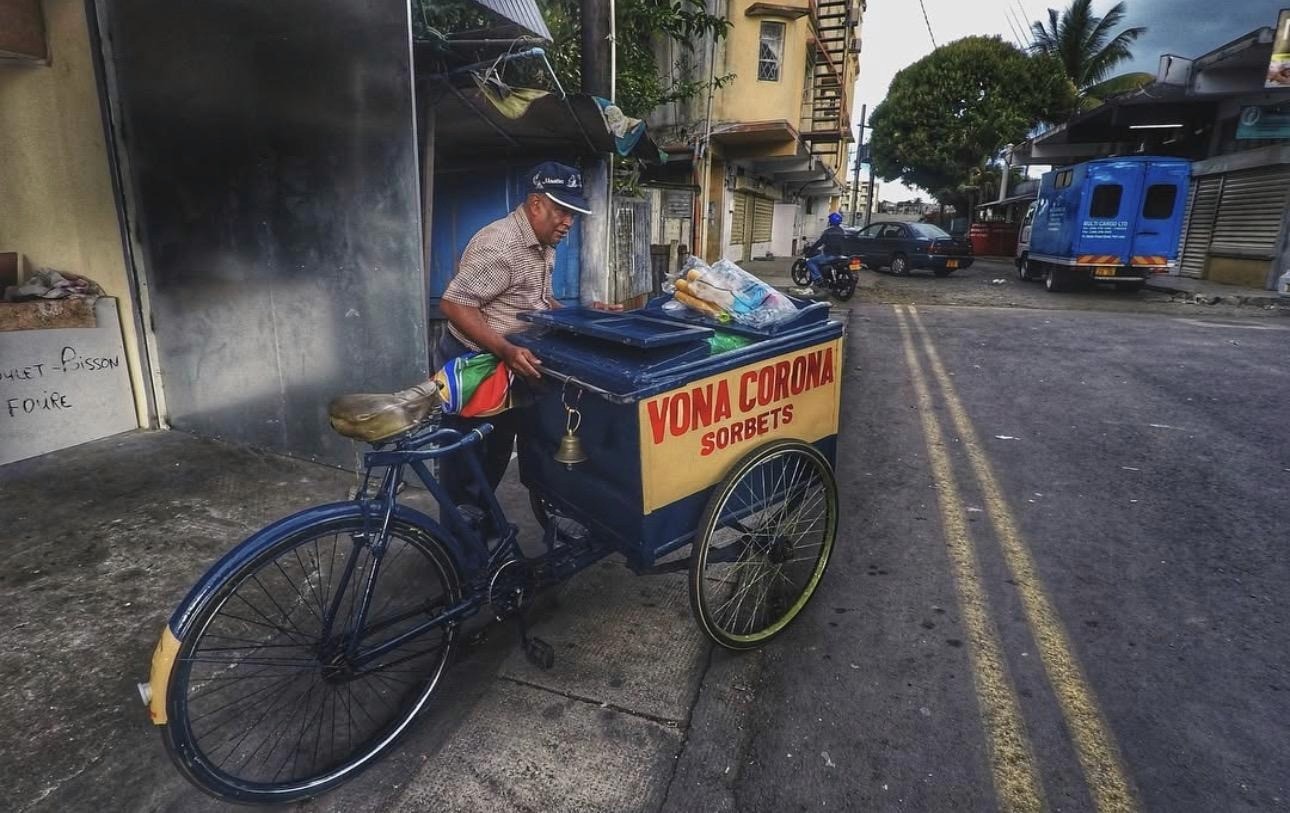
The day culminated in enjoying the island’s famous artisanal ice cream—Vona Corona—which is referred to by locals as “sorbet.” Usually it is a hand churned frozen treat that is traditionally sold by bicycle or tricycle carts. I love mine with its signature toppings: authentic pineapple jam and pink grated coconut. Vona Corona is a luxury to our inner child. I was missing it while eating it, knowing that more and more “sorbet” vendors are exiting the industry. I hope it doesn’t go extinct as long as I am alive.
A Conversation Found in Sand
This day’s vlog is sponsored by my mother who assigned me a very specific task: collect seashells for my twelve-year-old sister’s art project. Mont Choisy beach it is. There I was, scrutinizing the sand for perfect shells, assessing them based on cracks or faded colors. As I was moving further down the beach, I noticed another woman doing the same exact thing. I took one moment to admire her exquisite yet effortless fashion style: a long white crocheted skirt, a white top with a golden ornament sewn in, golden arm cuffs, Prada sunglasses and a birkenstock. That outfit was in my dream closet. That’s how our conversation started, over her majestic outfit. I was in absolute awe. Denise is a model ambassador, signed with Claudie Pierlot in Paris. That explained the gorgeous look. Eventually, we started talking about how my container was filling up faster than hers. I think I was just less picky but she would beg to differ. Denise has been collecting shells from every island she visited since she began traveling in her twenties: Santorini, Maldives, Seychelles, Fiji. Mauritius, however, was the first place where she admitted taking more than usual. She filled empty make-up glass containers with the seven colored earths of Chamarel, and took some smooth stones from Riviere des Galets as well. There was this childish innocence that I was feeling hearing her share this. Each time she would return to Paris, she would write a letter to her future self and store it with the shells for when she is “too old to travel”. That changed my perspective a bit. As an island girl, shells were something common for me. It turns out that they are worth more. A model collecting shells for her future self. I would assume all they do is enjoy the prestigious brand events, elegant runways and high-end gatherings. This meeting made me question if we appreciate life as we are meant to. Do we take too much for granted? Are we so busy chasing success that we forget to live? Are we living life right? Is there even a right way?
A Conversation Until Sunrise
However, the core essence of being human is adapting—which is what I have been practicing after the traumatic war experiences. My only panacea, until now, has been water. Certainly, there are days when I feel like staying indoors. But, I realized that I never once regretted going to the beach, but I do quite regret some days spent exclusively inside–-often filled with lethargy, loneliness or unproductiveness. As finals week approaches, I plan another trip to the water, as a de-stressor, on a Monday night. The day’s mission was crab fishing at night. It may sound odd if one is unfamiliar with island life—but trust the process. By 8 p.m., my cousins and I had already unloaded half the car onto the sand: portable barbecue grill, folding chairs, fishing nets and coolers overflowing with marinated meat. Not to forget, the necessities such as mosquito repellent cream and speakers. The beach at night and in the morning is poles apart. The same baby blue water turns pitch black, almost intimidating with moonlight reflecting on the surface. You do not see much of the sea, but you definitely hear the currents which sound much louder than during daylight. Soon, the grill was glowing orange, beneath the rows of chicken thighs coated in authentic Mauritian sauce made of honey, garlic, thyme, chili paste, onions, eggs and soy sauce. The butter dripping onto the charcoal occasionally made the flames flare up dramatically, but it was contributing to lightening up the atmosphere—just like disco lights one would see in clubs oscillating to the music’s frequency. Not to mention, it is not a beach night without the endless playlist of ‘Sega’ —the island’s unique music genre. The beats and rhythm are irresistible to any local; your feet refuse to stay still. As Mauritians say it, to “kill time,” we played cards, dominoes, and carrom until it was time to get to real business: crab fishing. One moment it was 10 p.m. and the next 2 in the morning and we were barefoot, walking along rocks with flashlights pointed toward small crabs hiding between crevices. Crab fishing requires more patience than skill. Your goal is to remain as still as a statue, waiting for small movements between the rocks. Most crabs escaped, but a few didn’t. However, my eldest cousin, the expert, had his bucket filled. The rest of us struggled a little but the experience was priceless. As usual, the night was not complete without the youngest, my sister, getting the smallest scratch on her arm and complaining for as long as she could. Soon, the mission was accomplished but no one wanted to leave. We spoke about everything: ancient horror stories, childhood memories, heartbreaks, ‘how-we-met’ stories, accidents and people. Around 5 a.m. exhaustion silenced us. Yet, it did not feel awkward at all. It was an ineffable type of peace. We sat facing the horizon with paper cups of sweet coffee from the nearby gas station, awaiting sunrise. Slowly, that black water softened into a grey tint of blue and the first fishermen appeared. I remember thinking about how absurd it was that in less than 3 hours I would be attending recitation online. By 7 a.m. the car was full again. The beach slowly woke up with more people appearing. A young couple stood near the shoreline, enjoying the sunrise intimately; a man photographed the filao trees from a distinct angle to capture the sky and the sea in one frame. My cousins and I had just spent the entire night there, laughing until our stomachs hurt, and chasing crabs on slippery rocks. We had shared our joy in the company of the ocean. Perhaps that was the reason why the night felt so light. My companion, the ocean, was next to me once again. Consistently, while I drift into new friendships, learn from brief conversations with strangers, or rejuvenate through time spent with my family. The waves never pause; they collapse within seconds as they wipe the footprints on the wet sand. And yet, a beautiful confidence settles that I will never be alone. The shore will wash up new opportunities, and the gushing of the water will remain by my side.
(photographs taken by author)