

MOMOMASERATI: On (Not)Belonging, Language, and National Identity
Momomaserati is a fashion designer, shop- and brandowner from Berlin. His parents are Iranian, and in this interview, he reflects on his (German) identity.
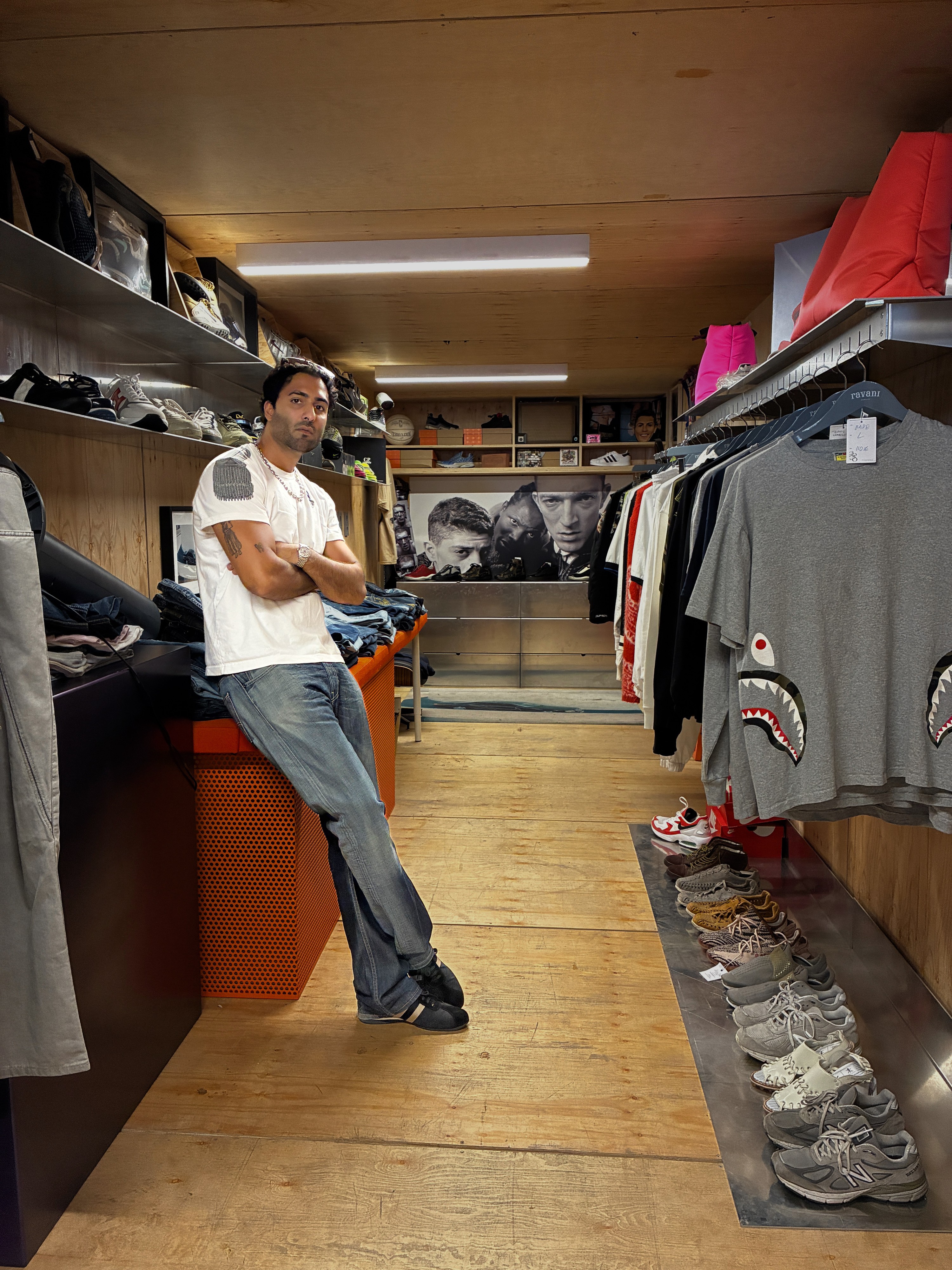
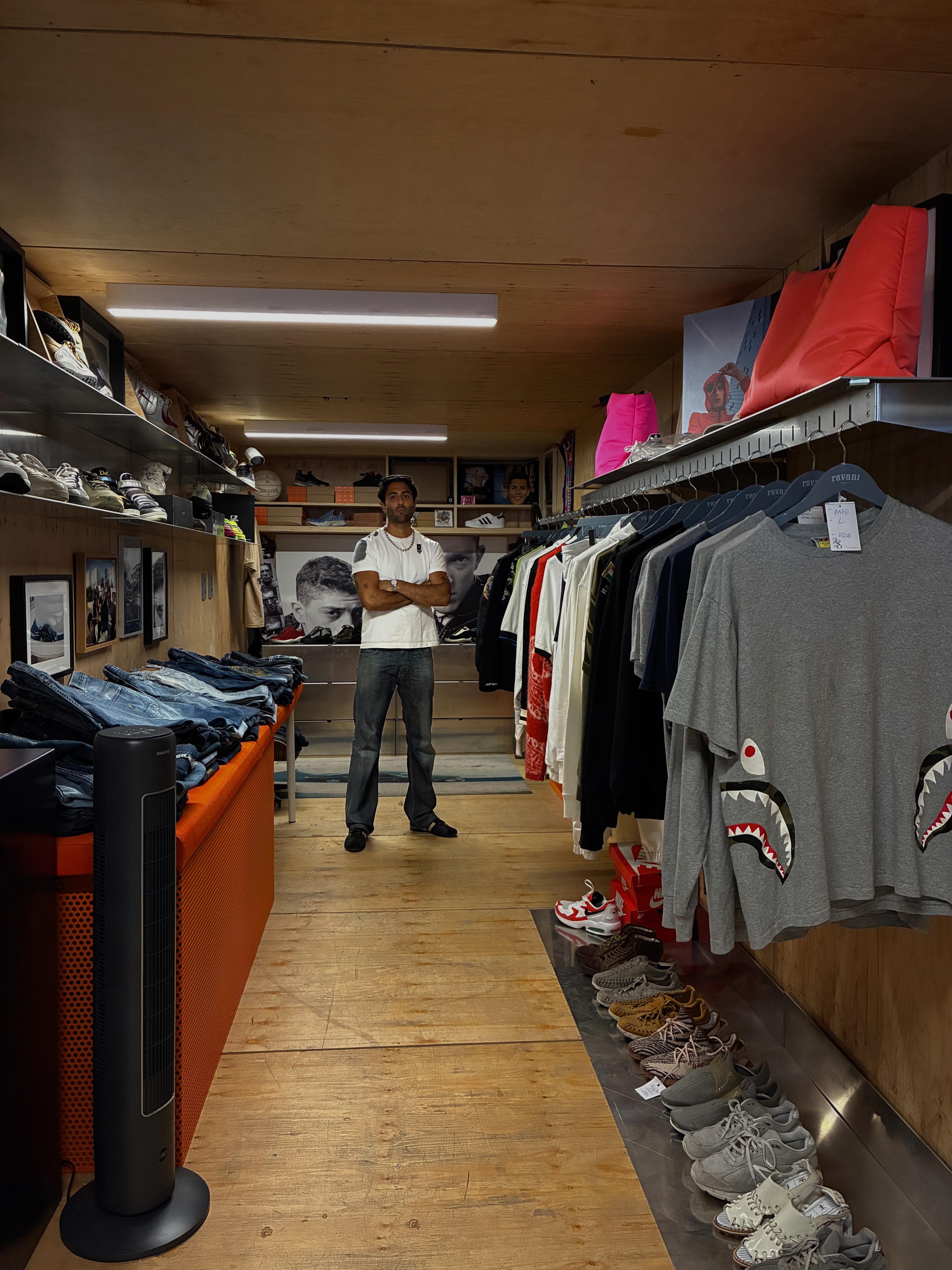
He is already standing outside the store when I approach. Located in the center of Berlin, surrounded by residential buildings, it has a warehouse look, painted entirely in striking blue. It does not fit in with the rest of the street’s architecture, but it makes a positive difference.
We go inside, where a handful of customers are roaming the clothing pieces on display.
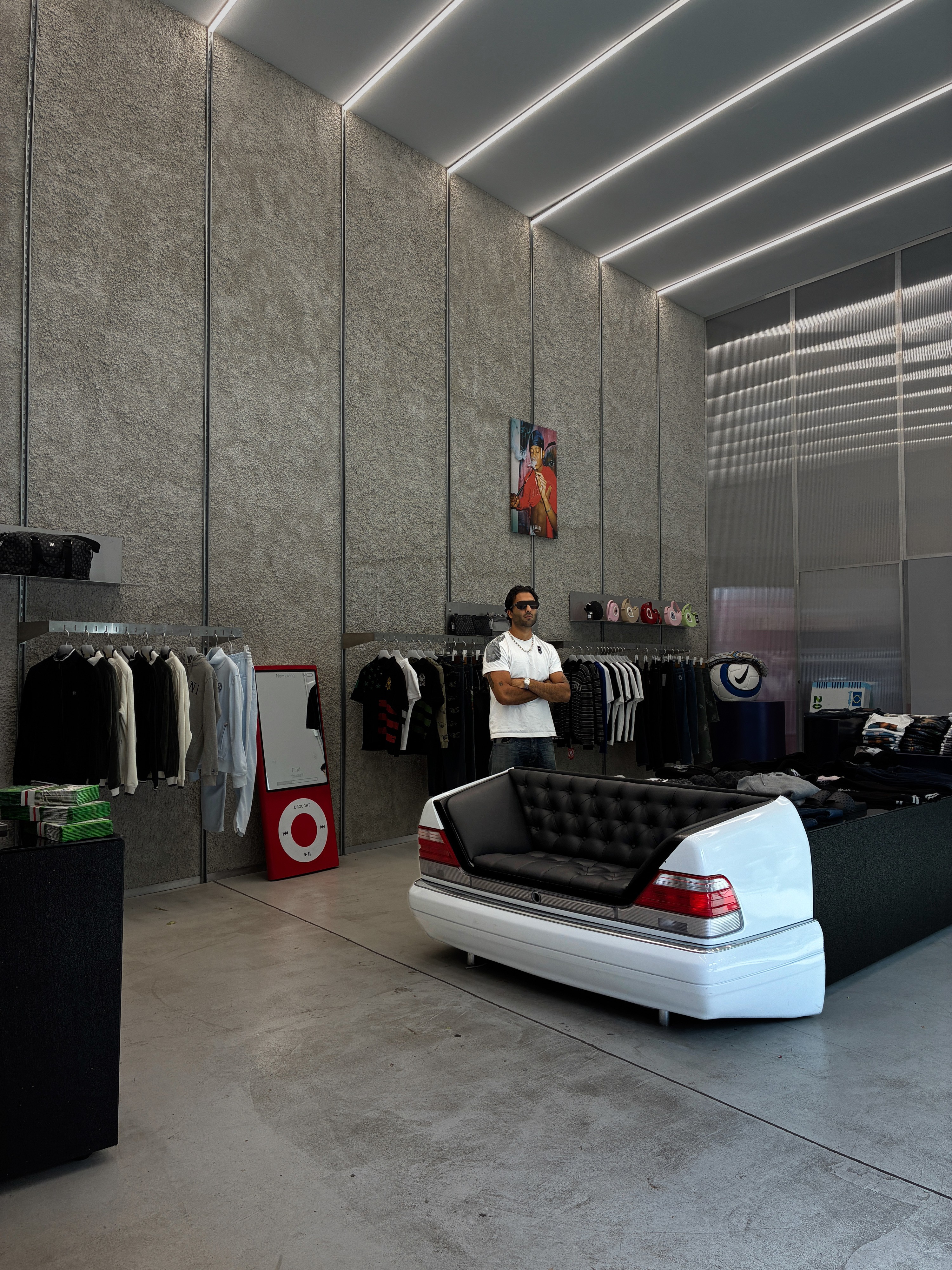
I greet the employees, and we go behind the cashier to the back. It is a stylish chaos, rhinestone jackets and printed shirts that say “Berlin Hates You”, or depict Ronaldo in the 2000s, are still wrapped in plastic and piled on signature furniture pieces. We go into the office space. He sits on the sofa that is designed to look like the trunk of the car, and I take a seat on the slouchy armchair parallel to the sofa, facing him.
Whilst responding, Momo unpacks piles of clothes and neatly places them on top of each other, next to him on the couch. Maybe doing something with his hands helps him concentrate.
MIRA: When you introduce yourself to strangers, what do you say?
MOMO: I just say: "Hey, I'm Shine."
MIRA: What do you say when they ask where you're from?
MOMO: I always say: "I'm Shine, I'm Iranian, but I grew up and was born in Germany."
MIRA: Did you grow up in Berlin?
MOMO: I was born and raised in Berlin, yes. Charlottenburg and Kreuzberg.
MIRA: What does Germany mean to you?
MOMO: Well, I spent a lot of my childhood in my own homeland...
MIRA: Mhm. Your own homeland, meaning Iran.
MOMO: In Iran, exactly. Yeah, okay, it's not actually my homeland per se, but you know what I mean. But even as a child — and this is actually a striking point — whenever I'd been there for six or seven weeks and came back, I was genuinely grateful as a kid to be back in Germany.
I appreciated German thoroughness — really simple things. For example, even as a child, what bothered me in so-called third-world countries was that they didn't tile the rooms properly, that everything was so imperfect. And in Germany, in every room every tile is perfect, because Germans follow norms, DIN standards, A4 and so on— you know, you think it's all so annoying, all this bureaucracy, but there's a huge system behind it. And as a kid I always thought it was so great: "Ah, back in Germany, everything so clean, straight, everything works."
MIRA: Orderly.
MOMO: Orderly, punctual, no nonsense. You know?
MIRA: So you'd say you're definitely German in your identity — if you were to define yourself by nationality, that is. I'm not sure if you do that, but if you did, it would be German?
MOMO: Well, I've been able to take on a lot of German virtues that I'm also very proud of. They do overlap in many ways with Iranian virtues, but things like punctuality, or keeping your word when you've given it — you know? I've definitely taken those on. But on the other hand, Germans also sometimes make things unnecessarily complicated, and that's when I notice how things work differently in other countries. A simple example that struck me even as a child: I was once at a supermarket, and I was literally two cents short. And the cashier refused to let it go. That would be unthinkable in other countries. Even if there's a corporate system behind it — even if it were two or three euros, everyone in the queue would be fighting to give you the money. And the cashier would say: "Just bring it tomorrow" — something like that. But in Germany, that would never happen.
I actually worked in a supermarket myself, and I often just did it out of my own mentality — even though I was in Germany — if someone was ten or twenty cents short, I'd say: "It's fine," and put it in from my own pocket. And that's one of those differences, I think personally.
MIRA: What things about yourself would you say are typical character traits that you’d describe as German?
MOMO: Well, I’m very punctual. That’s changed a bit over the years, but my whole life—because my parents really drilled it into me—I was always the type to be there 15 minutes early. That’s something very German about me. Another thing I’ve noticed is related to law and order. If someone really doesn’t follow an important rule, I completely lose it. Exactly like Germans.
And from a more literary perspective, I’d say that because Germany—and its literature—is seen as the “land of poets and thinkers,” as a German, especially with the German language, you’re shaped by how rational the language is structured. That makes you very inclined to overthink everything. For example, French is a very melodic, very passionate language in its tone.
And that reflects in the French lifestyle if you look at it. But German is very rational—very focused on structured thinking—and that tends to make people more rational as well.
I grew up with a second language too—Persian—which is very emotional. The complete opposite of German. It’s a language from the gut, from emotion, from the heart. So I noticed these differences very early on.
For me, when I think about what’s German about me, it’s definitely the language. I love German.
That’s how my mind thinks, and somehow it helps me move forward when I think in German.
MIRA: Around the world, people often have a bad impression of Germany because of its history. Do you ever get the impulse to defend all the other things that Germany is good at? Is it something worth defending to you, something you’re proud of?
MOMO: Well, I never really saw myself as German as a child and was always very proud of my own nationality. Also, when you grow up as a “Kanake” (a slur for Middle Eastern foreigners, reclaimed in some contexts) in Berlin, there’s always this dynamic… People with a migration background—ethnic minorities—are kind of low-key treated as second-class in society. That’s just how it is. And like in all cultures and big cities, people reclaim that. They develop their own slang—it’s all a form of empowerment. To build confidence.
So in my generation, people started to turn things around. In the 80s there was a lot of “stupid foreigner” type insults. But in the 90s and 2000s, it flipped—people started degrading Germans instead. Being German became uncool, and being “Kanake” suddenly became the coolest thing.
So much so that even Germans in my class would say they were “a bit Polish” or something, or they were ashamed to say they were German. It got to a point where, looking at it now, it’s actually kind of sad that Germans don’t feel good about their own identity anymore.
But I can’t say I was ever proud of being German, because I never felt 100% part of this country. Even as a kid—and still today—I experience passive racism daily.
And that’s in Berlin, which is supposed to be the most liberal, open, and culturally diverse city in Germany. I don’t even want to know what it’s like in smaller towns.
MIRA: Yeah, I understand that. I can relate. For me, growing up, I had friends whose families had these small garden houses (Schrebergärten) in Brandenburg. But my parents never allowed me to go there. They were afraid of me going there alone—anywhere outside Berlin.
MOMO: Until I was 17, I was afraid to go to East Berlin because I thought there were Nazis there.
MIRA: What changed when you were 17? I mean, there are unfortunately still a lot of Nazis.
MOMO: Funnily enough—techno. The music scene in Berlin. That’s when I realized that in that scene, there are no cultural boundaries or nationalities.
MIRA: Ah, interesting. So would you say that if you go out partying in East Berlin now, you wouldn’t run into Nazis?
MOMO ; Well, that was the case—most clubs were in East Berlin, so I had to go there. But yeah, East Berlin is still different from East Germany as a whole.
MIRA: You’ve said that you don’t feel 100% part of the country. How are you different from a ‘typical German’?
MOMO: Yeah. Um, no, I don't see myself that way, because I grew up with two cultures and I know the other side too. At some point it just comes out of you naturally. And you just notice you're not like that. Like with the supermarket thing, for instance. Although, you can't really generalize all of this. But I would say I am different. Starting with the way I look — that's where it already begins. But also mentality-wise a bit, you know?
MIRA: Yeah. That's interesting, because you say you don’t feel like you really belong within Germany, yet your work is a representation of Berlin, and maybe Germany. I think you’re part of a subculture that really shaped the image of Berlin for many people — especially those who aren't from Berlin.
MOMO: Yeah.
MIRA: Do you ever think about wanting to change the image of Berlin, for example? Or, say, when you go to L.A., that you could perhaps change a certain image of Germany? Are those kinds of thoughts you have?
MOMO: Whether I can do that?
MIRA: Yeah — like when you take your brand abroad. Or when you post on social media where, in a way, you represent Berlin for a lot of people, but you're not channeling that typical German thing. You know?
MOMO: Good question. I'd say no, because I think what stands for Berlin in the mainstream, or in the bigger picture, is — if anything — really just the techno and nightlife scene right now. And those people are very specific too. Starting with, for example, Berghain people — there are those memes and all those funny videos. Or the free-spirits type: Sisyphos, Kater Blau, that slightly hippie-leaning scene. And what I do is more Hip-Hop subculture. Mixed with 2000s vibes — Y2K, 2000s European style, Italian, French remix mashup. I'd say what I do is quite niche.
MIRA: I fully agree with you that it is a subculture — but I think it has actually risen high enough now that it's no longer really a subculture, but more like an alternative image of a more multicultural Germany, a younger creative Berlin, deeply connected to music, a lot tied to the Middle East, maybe Palestine and so on. All those directions.
MOMO: Yeah, absolutely — but I think that movement is European-wide, I'd say.
MIRA: Mhm. But wouldn't you say it's specifically tied to you?
MIRA: Was there a moment in the past — say in 2026 so far — where you felt genuinely proud to be German? A specific moment or...
MOMO: Nope.
MIRA: No? Does that rarely happen?
MOMO: There has never been a single moment, for as long as I've lived in Germany, where I've said to myself: "I'm proud to be German."
MIRA: Really?
MOMO: I think there was a time when I would have been proud of Germany. In the 80s I probably would have been very proud to be German, because the country functioned excellently. It stood for quality. It was a world power in the automotive industry and beyond. I think you could have been genuinely proud back then.
But unfortunately, I didn't experience that era. I unfortunately experienced the downfall.
And so I'm absolutely not proud to be German, and I no longer see my future here. That's why I'll be leaving soon.
MIRA: Last question: when you think about Germany's future, what feeling do you get?
MOMO: A very, very dark feeling. A very bad feeling. That's why I want to emigrate.
MIRA: Do you know where yet?
MOMO: Hm, definitely somewhere with a Mediterranean climate— where the people, in terms of appearance, are closer to how I look. Like Portugal, Greece — I found it very pleasant there, the mentality, the people, the climate, the food, the laws.
MIRA: Interesting. Yeah, I have to say — when I went to Abu Dhabi, I think the most positive thing or the starkest difference was that I was just... normal. I mean, here — even at work — every single day I'm told fifteen thousand times, and sometimes it's meant as a compliment, but: "You look special, you look like this and that." Always with the undertone of: you just don't look like everyone else, that's why I noticed you.
MOMO: Yeah, you don't look like a German.
MIRA: Exactly. And I've never heard that in Abu Dhabi. And it was such a refreshing feeling to suddenly have an average look. So I can absolutely understand that, and it genuinely improved my quality of life, because I simply didn't feel like everyone was staring at me for looking different. When I was younger, I always thought I looked German. I was always surprised when people said: "You're not quite from Germany." Because I thought: "Wait, my skin tone isn't that different..." And then at some point I looked in the mirror long enough and thought: "Okay yeah, I guess I do have slightly Asian-looking eyes or whatever."
MOMO: Right, that's always what I thought — it's actually not that... what's the word, exotic, but they always use that word, exotic.
MIRA: I’ve heard that so many times too. Its problematic. A person can't be exotic. A fruit can be exotic, but a person can't be exotic.
MOMO: You have no idea how often I've been told how exotic I look. I also once heard the word "rassig."
MIRA: Oh. Someone said that to you?
MOMO: Yeah. "You look really rassig." And I just thought: "Okay."
MIRA: That's wild, I've never heard that. What does it even mean? Like a race or something?
MOMO: No, "rassig" means like... southern-looking, Mediterranean.
MIRA: I've never heard that word, but it sounds terrible.
MOMO: Yeah, I don't like it either—
MIRA: It just sounds bad.
MOMO: Yeah.
MIRA: I’m glad we had this conversation. Is there anything else you'd like to share, anything that came to mind?
MOMO: No, nothing.
MIRA: Okay, cool. Thank you.
The respondent is independent, owns a fashion brand, and is considered a “face of Berlin” to some people. The social spheres he frequents perhaps link quite well to the question of the (German) identity. His cultural presence exists between the ‘legitimacy’ of owning a successful streetwear brand, not drinking or doing drugs, and living in Charlottenburg, a fancy part of Berlin. On the other hand, his customers and the ‘look’ that made his brand famous is that of the street rappers, the children of immigrants, often of Muslim backgrounds, who create their own subcultures in cities like Berlin.
Momo has Iranian parents and was born in Charlottenburg, Berlin. He, like me, looks “not-German”. In recent contemplations with myself and with others, I have become more aware of how these ethnic differences leave their mark on all identity “politics” of the individual. Even if I felt 100% German, my looks would negate that for those around me. What does it look like to experience national community and identity in the face of this everlasting conflict? During my conversation with Momo, similar topics came to the surface.
The nuance, self-critique, and the undeniable, everlasting presence of the Other, of the external judge, are compelling for further investigation, and concerning as a private observer.